Toxic Gas Sensors

Those of you who have been to the /tmp/lab may have experienced the delicate smells of the nearby chemical factory.

We want to learn more about this pollution, so we will implement an automated measurement system.

To monitor the air concentration of pollutants, we use cheap sensors made by a company called Figaro. The models used are TGS2600 and TGS2602; the same are used by the FridaV project. The TGS2600 measures contaminants such as hydrogen and carbon monoxide, while the TGS2602 detects ammonia and hydrogen sulfide (that we think is responsible for the occasional foul smells at the lab).

The outputs of these sensors is digitized and sent to an advanced Arduino called Fonera. It even has 802.11! And it can run Linux! Those features of this Arduino for experts (we hope we will be still able to use it despite our little DIY skills) make it perfect to post automatically the results on the web, by using the popular Twitter for example.

We are thinking about using a SPI analog to digital converter, as the Arduino hardware seems to be able to handle it.

More to come soon, check out the wiki page.
FPGA Workshop #3: Computer Architecture, August 29th

Computer architecture is the science and art of selecting and interconnecting hardware components to create computers that meet functional, performance and cost goals (Wikipedia).

With the invasion of digital devices during the last decade (cellphones, wireless routers, digital TV…), it has become more than ever ubiquitous.

However, it is still a poorly known subject for most people. Even among the self-proclaimed hardware hacking community, most fanatics of the Arduino development board open source physical computing platform do not know that all the functionality of their much-hyped toy comes from an AVR microcontroller chip that has been being manufactured for years by Atmel. And among those who know, yet fewer people are knowledgeable about the inner working of the AVR microchip; in which computer architecture plays an important role.

The reason behind this might be that during decades, computer architecture was reserved to academic lectures and companies who had enough cash to build integrated circuits costing several hundreds of thousands of dollars. This left little room for the individuals, except those who had the guts to wire together hundreds of logic ICs together. But these amateur systems lag well behind commercial solutions in terms of performance, size, and power consumption.

But today’s falling costs of powerful FPGAs make it possible for individuals to build complete high-performance computer systems (System-on-Chips) from scratch.

This workshop will explore this possibility. After introducing basic computer architecture concepts and practices, we will load a simplified version of the Milkymist System-on-Chip design in the development boards and execute basic programs on it. Then, using Verilog HDL, we will design a simple peripheral for the system-on-chip, integrate it, and test it on the board.

This workshop is for people who want to discover practical computer architecture, and at the same time for those who already know about architecture and want to get an introduction about how to add a peripheral to the open source Milkymist System-on-Chip.

Date: August 29th, 14:00
Venue: /tmp/lab geek collective
Price: Free
Info+Registration: Workshop page

Church of Security

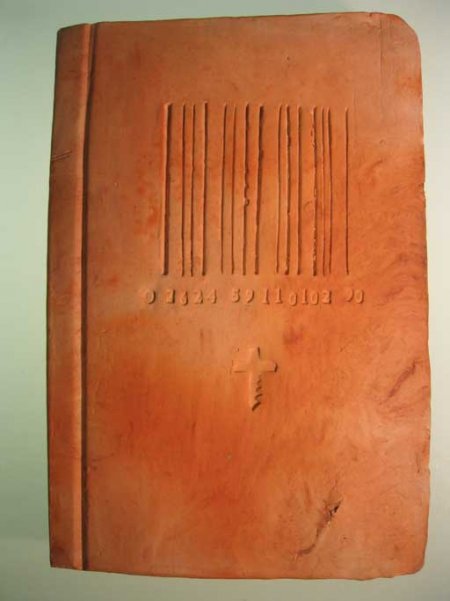
Church of Security opened its temporary chapel last week. Preaching about the over-development of surveillance and the creative space it created for us, believers, who will use Infrared-Blinder for CCTV, Consumer B Gone to prevent highly dangerous terrorist from stealing your shopping cart in the supermarket, RFID detection and activation Crosses and other artifacts during our constant celebration of the all-seeing, all-knowing (yet slow to act) God of Security. Allelujhack!

Consumer B Gone at 25C3

Don’t miss out the lightning talk we will be giving today at 25C3 on Consumer B Gone !

At approx 12 in Saal 2. More info on these pages :
Consumer B Gone : http://www.tmplab.org/2008/06/18/consumer-b-gone/
Lightning talks : http://events.ccc.de/congress/2008/wiki/Lightning_Talks#Talks_-_Day.234
And for those who are not at the 25C3, there is streaming video : http://events.ccc.de/congress/2008/wiki/Streaming

Consumer B Gone

Consumer B Gone enables you to block a shopping cart by just playing some tones out of your mobile phone speaker as a song or as a ringtone. Consumer B Gone is born from the incredible shock that the shopping cart wheel could be remotely locked if you tried to exit the supermarket parking lot.

The root cause of it was an antenna (a wire in the ground at the exit of the parking lot) which sent a “Lock” signal to 2 of the 4 shopping cart wheels.

If an antenna can do it, I can do it too! The first idea that emerged was to create some hardware to generate such signal… but the hardware didn’t work, so the logic was to test the generated signal against the original signal… and to use a soundcard to record both!

Well… if one soundcard can record, maybe it could be used also to replay??? Replay of course in the adequate coil that serves as an antenna… But hey, wait! What if the coil to be used was the one in the computer’s speaker? Guess what: IT WORKS.

And what about an MP3 File on mobile phones? Guess what again, IT WORKS TOO!!! 🙂

Continue reading “Consumer B Gone”

OLPC Sugar on EEE pc with bootable USB key and OLPC XO emulation fun

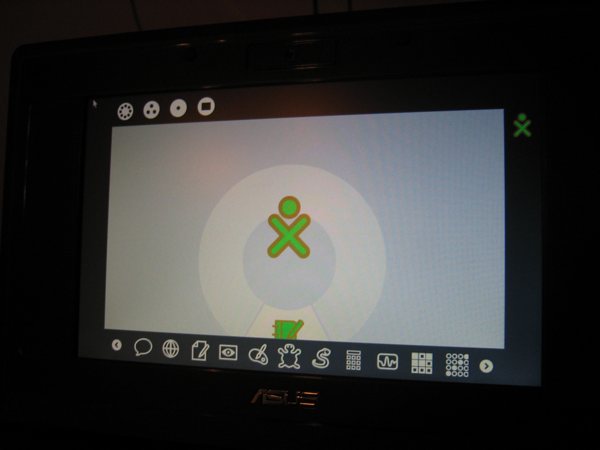
Sugar on EEE pc using XubuntuAfter the BackTrack3 Live SD card for EEE, I continued the distribution exploration with the OLPC (One Laptop Per Child) operating system on their brand new XO laptops and their slick and simple GUI called Sugar.

Before jumping into “did this, done that”, current advances in SD card and USB memory sticks sizes, bootable distribution and virtualization take computing to a different level.

Remember when you use to insert a MSDOS diskette into your computer to boot it? Each new operating system could be booted on the same old PC by merely changing the diskette and rebooting? Of course, there were not as many OS as now. This is where the fun begin.

Now, a child can have “his own computer” by just possessing a SD-card. All his changes to his environment will be persistent. He will be able to add programs without depending or affecting anyone. 2 Gb SD card are as cheap as 10 euros now. On such a card, you can have OLPC Sugar, Ubuntu or Debian. And guess what, these are not mutually exclusive. For proof is my experiment by Booting my EEE pc with Xubuntu running Sugar GUI borrowed from standard OLPC / XO distribution. These SD or USB storage are bootable even if they are formatted as VFAT, that means, readable on a standard Windows PC.

On top of this, Kevin’s SD card or USB key may also store a Virtual Machine application (Qemu or Virtual Box are free alternatives to VMware) which may enable him to run his own environment without rebooting daddy’s computer. Such freedom may transform PCs into a commodity where you actually boot your own environment.OLPC XO Sugar emulation fun

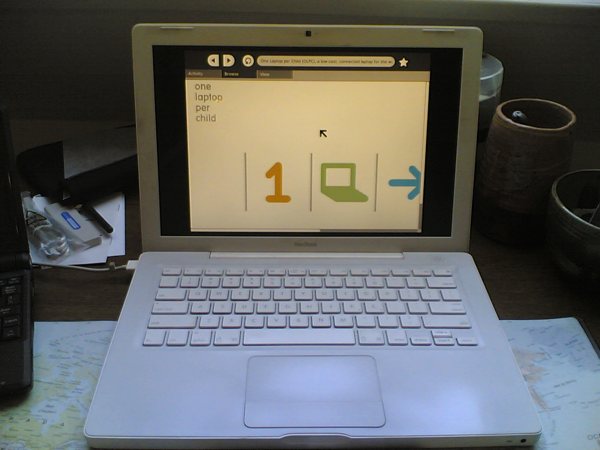
Speaking of which, I did some test also running OLPC XO Fedora Core-based distribution in VMware Fusion on my MacBook and it runs nicely, without crashes or else.

An astronomical experiment

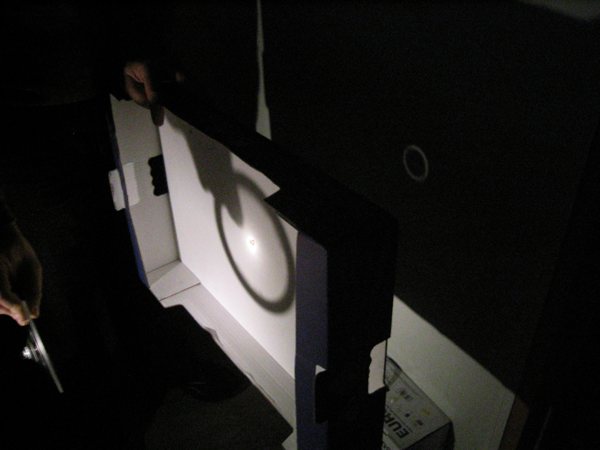
the gravitational lens and a Einstein ringIn the dark quietness of the lab, using a special lens shaped like the leg of a wine drinking glass, a light source, and a piece of cardboard, we saw the Einstein Ring today. In space, these rings and associated shapes appear when light from distant sources is bent by a massive galaxy or group thereof. Our lens bends light exactly the same way a black hole weighting 75% of Earth mass would. This experiment, and the background about this phenomena are described in details in the paper didactical experiment on gravitational lensing

EEE boots on USB & SD card

Here is a Tutorial on how to boot your EEE pc with USB-key or SD-card that I wrote coming back from Indonesia.

The cool thing is that you can have as many 1Gb or 2Gb SD-cards for as many distribution you need to work with. Let’s say you need to use Debian for some compile jobs, Nexenta for some Open Solaris testing and Backtrack3 for some security/hacking jobs? Easy, you just install each of these distribution on a different SD-card (10 euro these days for a 2Gb SD-card) and using one is just as easy as changing disks and rebooting it.

As we are also developping the OLPC France initiative, EEE pc provides an interesting alternative to the XO. Being able to test out the distribution in such a way adds to the “technology fluidity” of such platforms. More to come 😉

SkyLight

One of our first project is to get proper sunlight into the basement. We have thus started to work on a SkyLight that will provide us with light similar to the sun (below this thick concrete shelter).

Currently our plans are to use 6000K fluorescent tubes that provides “Daylight” glare, combined with colored lights that will restore a warm atmosphere.