A Berlin ! A Berlin !

Chaque fin d’année apporte avec elle son lot de fêtes, la principale étant bien sur Noël^Wle Nouvel An^W^WChaos Communication Congress. Respectant la tradition, le /tmp/lab y sera, et fort bien accompagné car depuis l’an dernier, d’autres hackerspaces se sont montés sur Paris. Une page est donc apparue dans le wiki afin de préparer l’expédition parisienne au coeur des étendues hostiles et glacées de la Teutonnie. Gageons que le passage de nos vaillants aventuriers marquera la mémoire des générations présentes et à venir …

N’oubliez pas que Berlin est un haut lieu de la teuf de ouf guedin malade, et que les hotels se remplissent très vite. Donc courrez vite vous inscrire !

Atelier “Logiciel embarqué sur Milkymist”

Description
Ceci n’est pas un workshop FPGA.
Cet atelier présente des techniques de base utilisées pour la plupart des développements logiciels “bas niveau” sur systèmes embarqués, toutes plate-formes confondues (microcontrôleurs, system-on-chips [un system-on-chip n’est rien autre qu’un “gros” microcontrôleur], calculatrices, cadres photo, …). Il présentera ensuite des aspects spécifiques au system-on-chip libre Milkymist tels que la programmation graphique et l’emploi de ses accélérateurs de calcul.

Les points suivants seront abordés:

  • Pré-test d’un programme sur PC
  • Installation et utilisation d’un compilateur croisé
  • Chargement du programme dans la carte de développement
  • Bases de programmation graphique bas niveau
  • Utilisation des accélérateurs graphiques sur Milkymist

Pré-requis
Cet atelier s’adresse aussi bien aux débutants complets en programmation embarquée qu’aux personnes ayant déjà programmé sur plusieurs plate-formes et désirant se familiariser avec l’utilisation des périphériques de Milkymist.

  • Venez avec votre ordinateur portable sous Linux ou *BSD. De préférence Ubuntu ou Debian mais ce n’est pas obligatoire.
  • Connaissances de base sur la ligne de commande de Linux (cd, ls, rm, etc.)
  • Connaissances de base en C. Pour les fans de déambulateurs, je rappelle que le Arduino Programming Language(tm) est du C et que si vous savez faire clignoter une LED en l’utilisant c’est suffisant. Si vous programmez sur PC et que vous savez faire afficher les nombres de 1 à 10 avec une boucle, c’est également suffisant.
  • Si vous avez une carte à microcontrôleur AVR, vous pouvez aussi l’amener (pour pouvoir comparer). Les Arduinos sont tolérées.

Week-end de nerd
Vous êtes également bienvenus à l’atelier FPGA Workshop 4: Behind the Scenes le lendemain. Merci de vous y inscrire également si vous souhaitez participer.

Infos
Date: Samedi 7 novembre 2009, 14:00
Lieu: /tmp/lab
Merci de vous inscrire en éditant la page wiki.

Looking for multimedia artists

We are looking for multimedia (mostly graphics) artists for a democompo project. You do not need to have an expert level in programming to participate (if your only contribution is good looking bitmap images, that’s already a lot!), even though a little background is advisable if you want to do animated thingies or some rendered effects (we could help you however).

This mini-project consists in developing a compo on the Milkymist open hardware system-on-chip platform that will present Sanobot, the toxic gas sensor and Twitter bot of /tmp/lab, a hackerspace set up close to a chemical factory.

We look forward to presenting it at demoparties (unfortunately it was not ready for Main#4).

What is a Demoparty:

More info on Sanobot:

More info on Milkymist:

Project wiki page (with scenario outline… that you are of course invited
to improve):

So if you think you could design some cool graphics for this project, contact sebastien dot bourdeauducq at lekernel dot net. There is nothing to win, except loads of geek fun, some technical background, and hopefully a demoparty prize 😉

FPGA Workshop 4: Behind the Scenes (November 8)

DESCRIPTION
In the previous workshops, we have seen that FPGAs can emulate any logic circuit without moving (mechanical) parts.

FPGAs are however not magic nor mystical devices and this workshop will shed light on how they work internally. After theoretical explanations on their functioning, we will program them very close to the “bare silicon” by configuring manually each logic element on the chip, without any Verilog or schematics.

This will give you a better understanding of the challenges involved with writing open source programming tools, reverse engineering existing FPGA designs, injecting backdoors into FPGA bitstreams, and squeezing the most performance out of an FPGA chip.

PREREQUISITES
For the hands-on part:

  • Bring your laptop
  • IMPORTANT: Install Xilinx ISE. The installation takes a long time that we cannot waste during the workshop.
  • Bring a Xilinx FPGA board such as the Avnet Spartan-3A starter kit used in previous workshops.
  • The board must have a Xilinx FPGA. Boards with non-Xilinx chips cannot be used.
  • Your board must have at least 2 pushbuttons and 2 LEDs.
  • Bring any required programming (JTAG) cable and try to make sure that it works (driver installed etc.) before coming.

You can come to the workshop without a board, but obviously you might be unable to perform the manipulations yourself.

PRACTICAL INFO

Security: do avatars dream of digital sheep?

There will be a round table during the first instance of Open World Forum in Paris with one of /tmp/lab member (Philippe Langlois) on Thursday 1st of October 2009.
The theme of the roundtable is “Internet 3: new era of freedom, or a totalitarian nightmare? Virtual worlds and multiple identities: are we heading for digital schizophrenia? Data protection, individual liberties and a private life, traceability… What are the technological implications? New directions for Open Source? “.

Abbenay Hackerspace – Call for Support

The Abbenay hacklab [1] opened early this month in Stockholm [2], where a
housing crisis is at full blow.

We are set up in a place that was squatted downtown by Kommando Carl Bildt
since late August, called AK4. The house was empty since June, and there was
no plans to use it until one year and a half.

Unfortunately, squats are very unusual in Sweden, and the discussions with the
landlord and the city of Stockholm are extremely difficult, even though many
newspapers speak positively about AK4. The place currently sets a record for
the country, with a life time of one month (and counting) while most squats
usually get raided by the police in a few days.

We are however facing an imminent eviction threat and police pressure has been
significantly increasing lately – with civil cops coming very often to take
pictures of the house and sirens waking us up early in the morning.

This call is asking you to contact the landlord to show support to the hacklab
and the squat. So far, he has been very closed minded. He only proposed that
we leave the place and talked about an expensive and abusive rental contract.
It was about a much smaller office, and according to which we would not be
allowed to sleep in the premises, we would not be allowed to host concerts,
cafes or parties, etc.

The landlord is Fredrik Winberg; he is the CEO of Cementa AB [3], part of
HeidelbergCement Global with a revenue of 15 billion euros per year. He also
runs the Biteam AB company [4].
We do not believe that he or any of his fellows will turn poor should we
definitely get the house in Stockholm, and we think that his behavior is
basically motivated by the capitalist idea that the right to stay somewhere
must always be paid for.

We hereby ask you to contact him to expose your views on squatting and
hackerspaces in order to give him a more comprehensive view on the subject
than what he could have had as a capitalist entrepreneur. His contact email is
fredrik.winberg at cementa.se and he can be reached by phone at
+46 (0)708 25 68 04 (NB: this contact information is available from the WWW).

We do not give a “copy and paste” email to send him, since mail bombing would
probably not be effective and only increase tensions. Also, please do not be
aggressive nor engage in any other activity (defacing etc.) which would not
lead anywhere.

You are also most welcome to join the AK4 Squat Support Group on Facebook:
http://www.facebook.com/home.php#/group.php?gid=146697601021

Thank you,
The Abbenay Hacklab

PS. We are very grateful for any distribution of this call. Print it, forward
it, post it on your blog, upload it to your favorite social network, etc.

[1] http://www.abbenay.org/
[2] http://lekernel.net/blog/?p=544
[3] http://www.masterclub.se/konsulter.html (Swedish)
[4] http://www.biteam.com/

Sanobot data for the first half of September

The CSV data from Sanobot for the first half of September is now available here: sanobot_half_sept.csv. Sanobot is the toxic gas sensor and Twitter bot of /tmp/lab.

The first column of the CSV gives the Unix time at which the measurement was taken. The other two columns are the ADC output for respectively the TGS2602 and the TGS2600.

For information about how to interpret the data, see here: http://lekernel.net/blog/?p=509 and http://lekernel.net/blog/?p=517.

Using the full CSV data, we can now try to figure out when is the best time to trigger the Twitter alert. For now, it posts a new alert when one value varies by more than 30% compared to the last posted.

NB. The huge peaks are because of people playing with cigarettes near the sensors. Smoking kills.

Distributed SAT Solver Cryptanalysis went great!

Buenos Aires, Argentina urban artMate Soos gave us a great workshop on SAT Solver Cryptanalysis and his project about Distributed SAT Solving. As soon as I’m back from ekoparty (Buenos Aires, Argentina), I will try what he posted on the /tmp/lab mailing list.
In the meantime, life is blooming in Paris with now 5 hacker spaces starting or alive and kicking! 🙂
(La Suite Logique : http://www.lasuitelogique.org/, La porte logique, Free Fermentology Foundation : http://kefir.wikidot.com/, Digital Non-Sense, et /tmp/lab bien sur).

Pollution sensors experiments

We have started experimenting with the air pollution sensors.

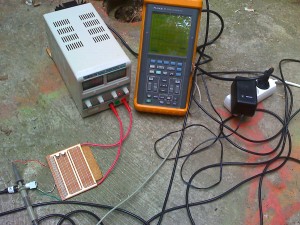
First setup:
First experimental setup

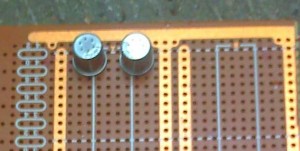
The Figaro gas sensors mounted on a piece of Veroboard:
veroboard2-300x151

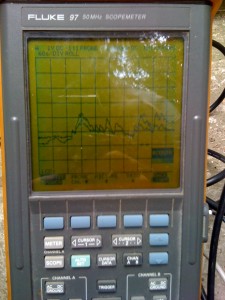
View of the big scary Arduino used to plot the first graphs. 1min/div. Looks like it’s working as both smell (from the chemical factory) and measured voltage go up during the third minute:
IMG_0312-225x300

More to come soon!

Stages au /tmp/lab – internships

Vous voulez avoir un stage intéressant? Travailler sur de l’Open Source? Ne pas bosser pour des prunes pour Google? Bosser avec des gens venant d’horizon variés et possédant une vraie passion et une vraie expertise technique (wow, ca commence a ressembler a une pauvre annonce de RH toute naze 😉 hehe), eh bien maintenant c’est possible car on ouvre les stages au /tmp/lab. Contactez nous si ca vous interesse.

Want to have a cool internship working on open source software? Don’t want to work for peanuts for Google? Want to have your own agenda? Join the /tmp/lab and make your internship into a unique experience. French or English speaking welcome.

Plus de détail sur les sujets possibles / More details on possible subjects:
http://dev.tmplab.org/issues/show/97

Some of the proposed projects:

  • Streamster2: Easy to use, Advanced TOR-like network
  • HostileWRT: Shell, C or Lua code on WiFi, security, audit, embedded platforms.
  • RubySCTP: Ruby SCTP stack with the same API as pySCTP (based on lksctp / SCTP socket API)
  • FasterJasperRb: Ruby Jasper Reports accelerated report server (as suggested in http://wiki.rubyonrails.org/rails/pages/HowtoIntegrateJasperReports)
  • Redmine improved interface to manage bugs and edit Wiki
  • Input engine for Redmine Wiki (to make it accept Trac wiki syntax, Mediawiki syntax, …)
  • BrokenTV key: Linux-based USB key for journalism in censored/hostile territories
  • BrokenTV platform: Free and Open source platform for Open / Mutable Web TV broadcasting
  • Anti-MitM: Detect and block Man in the Middle attacks with forged SSL certificates

if you have a project you’d like to propose, please tell us, we are also welcoming outside student / research projects.

Toxic Gas Sensors

Those of you who have been to the /tmp/lab may have experienced the delicate smells of the nearby chemical factory.

We want to learn more about this pollution, so we will implement an automated measurement system.

To monitor the air concentration of pollutants, we use cheap sensors made by a company called Figaro. The models used are TGS2600 and TGS2602; the same are used by the FridaV project. The TGS2600 measures contaminants such as hydrogen and carbon monoxide, while the TGS2602 detects ammonia and hydrogen sulfide (that we think is responsible for the occasional foul smells at the lab).

The outputs of these sensors is digitized and sent to an advanced Arduino called Fonera. It even has 802.11! And it can run Linux! Those features of this Arduino for experts (we hope we will be still able to use it despite our little DIY skills) make it perfect to post automatically the results on the web, by using the popular Twitter for example.

We are thinking about using a SPI analog to digital converter, as the Arduino hardware seems to be able to handle it.

More to come soon, check out the wiki page.

FPGA Workshop #3: Computer Architecture, August 29th

Computer architecture is the science and art of selecting and interconnecting hardware components to create computers that meet functional, performance and cost goals (Wikipedia).

With the invasion of digital devices during the last decade (cellphones, wireless routers, digital TV…), it has become more than ever ubiquitous.

However, it is still a poorly known subject for most people. Even among the self-proclaimed hardware hacking community, most fanatics of the Arduino development board open source physical computing platform do not know that all the functionality of their much-hyped toy comes from an AVR microcontroller chip that has been being manufactured for years by Atmel. And among those who know, yet fewer people are knowledgeable about the inner working of the AVR microchip; in which computer architecture plays an important role.

The reason behind this might be that during decades, computer architecture was reserved to academic lectures and companies who had enough cash to build integrated circuits costing several hundreds of thousands of dollars. This left little room for the individuals, except those who had the guts to wire together hundreds of logic ICs together. But these amateur systems lag well behind commercial solutions in terms of performance, size, and power consumption.

But today’s falling costs of powerful FPGAs make it possible for individuals to build complete high-performance computer systems (System-on-Chips) from scratch.

This workshop will explore this possibility. After introducing basic computer architecture concepts and practices, we will load a simplified version of the Milkymist System-on-Chip design in the development boards and execute basic programs on it. Then, using Verilog HDL, we will design a simple peripheral for the system-on-chip, integrate it, and test it on the board.

This workshop is for people who want to discover practical computer architecture, and at the same time for those who already know about architecture and want to get an introduction about how to add a peripheral to the open source Milkymist System-on-Chip.

Date: August 29th, 14:00
Venue: /tmp/lab geek collective
Price: Free
Info+Registration: Workshop page

Distributed Crypto SAT Solving workshop, Sept 10th

In this workshop led by Mate Soos (PhD in INRIA Rhone-Alpes) we will take a distributed SAT solver design that works similar to SETI@Home and hack it until it works faster, gives better results. The results will be public and the solver downloadable, along with the server to enable anyone to crack much-hyped but useless crypto-systems using collaborative effort.

SAT solvers are mathematical tools that solve problems given in the CNF notation. Since all problems can be described in CNF, in particular, cryptographical problems, SAT solvers can be used to crack ciphers. They have already been used to solve Crypto-1, used in London (20 seconds to break the encryption…) and HiTag2, used in car immobilizers.
Difficult cryptographic routines such as those used in WPA (wireless internet access), SSL (bank transactions), etc. need much more computing power than older ciphers. This means SAT solvers must be designed to work in a distributed environment, and work similar to SETI@Home or Folding@Home.

Date: September 10, 2009
Location: /tmp/lab, near Paris
More info+Registration: Worskshop page