Looking for multimedia artists

We are looking for multimedia (mostly graphics) artists for a democompo project. You do not need to have an expert level in programming to participate (if your only contribution is good looking bitmap images, that’s already a lot!), even though a little background is advisable if you want to do animated thingies or some rendered effects (we could help you however).

This mini-project consists in developing a compo on the Milkymist open hardware system-on-chip platform that will present Sanobot, the toxic gas sensor and Twitter bot of /tmp/lab, a hackerspace set up close to a chemical factory.

We look forward to presenting it at demoparties (unfortunately it was not ready for Main#4).

What is a Demoparty:

More info on Sanobot:

More info on Milkymist:

Project wiki page (with scenario outline… that you are of course invited
to improve):

So if you think you could design some cool graphics for this project, contact sebastien dot bourdeauducq at lekernel dot net. There is nothing to win, except loads of geek fun, some technical background, and hopefully a demoparty prize 😉

FPGA Workshop 4: Behind the Scenes (November 8)

DESCRIPTION
In the previous workshops, we have seen that FPGAs can emulate any logic circuit without moving (mechanical) parts.

FPGAs are however not magic nor mystical devices and this workshop will shed light on how they work internally. After theoretical explanations on their functioning, we will program them very close to the “bare silicon” by configuring manually each logic element on the chip, without any Verilog or schematics.

This will give you a better understanding of the challenges involved with writing open source programming tools, reverse engineering existing FPGA designs, injecting backdoors into FPGA bitstreams, and squeezing the most performance out of an FPGA chip.

PREREQUISITES
For the hands-on part:

  • Bring your laptop
  • IMPORTANT: Install Xilinx ISE. The installation takes a long time that we cannot waste during the workshop.
  • Bring a Xilinx FPGA board such as the Avnet Spartan-3A starter kit used in previous workshops.
  • The board must have a Xilinx FPGA. Boards with non-Xilinx chips cannot be used.
  • Your board must have at least 2 pushbuttons and 2 LEDs.
  • Bring any required programming (JTAG) cable and try to make sure that it works (driver installed etc.) before coming.

You can come to the workshop without a board, but obviously you might be unable to perform the manipulations yourself.

PRACTICAL INFO

Security: do avatars dream of digital sheep?

There will be a round table during the first instance of Open World Forum in Paris with one of /tmp/lab member (Philippe Langlois) on Thursday 1st of October 2009.
The theme of the roundtable is “Internet 3: new era of freedom, or a totalitarian nightmare? Virtual worlds and multiple identities: are we heading for digital schizophrenia? Data protection, individual liberties and a private life, traceability… What are the technological implications? New directions for Open Source? “.

Abbenay Hackerspace – Call for Support

The Abbenay hacklab [1] opened early this month in Stockholm [2], where a
housing crisis is at full blow.

We are set up in a place that was squatted downtown by Kommando Carl Bildt
since late August, called AK4. The house was empty since June, and there was
no plans to use it until one year and a half.

Unfortunately, squats are very unusual in Sweden, and the discussions with the
landlord and the city of Stockholm are extremely difficult, even though many
newspapers speak positively about AK4. The place currently sets a record for
the country, with a life time of one month (and counting) while most squats
usually get raided by the police in a few days.

We are however facing an imminent eviction threat and police pressure has been
significantly increasing lately – with civil cops coming very often to take
pictures of the house and sirens waking us up early in the morning.

This call is asking you to contact the landlord to show support to the hacklab
and the squat. So far, he has been very closed minded. He only proposed that
we leave the place and talked about an expensive and abusive rental contract.
It was about a much smaller office, and according to which we would not be
allowed to sleep in the premises, we would not be allowed to host concerts,
cafes or parties, etc.

The landlord is Fredrik Winberg; he is the CEO of Cementa AB [3], part of
HeidelbergCement Global with a revenue of 15 billion euros per year. He also
runs the Biteam AB company [4].
We do not believe that he or any of his fellows will turn poor should we
definitely get the house in Stockholm, and we think that his behavior is
basically motivated by the capitalist idea that the right to stay somewhere
must always be paid for.

We hereby ask you to contact him to expose your views on squatting and
hackerspaces in order to give him a more comprehensive view on the subject
than what he could have had as a capitalist entrepreneur. His contact email is
fredrik.winberg at cementa.se and he can be reached by phone at
+46 (0)708 25 68 04 (NB: this contact information is available from the WWW).

We do not give a “copy and paste” email to send him, since mail bombing would
probably not be effective and only increase tensions. Also, please do not be
aggressive nor engage in any other activity (defacing etc.) which would not
lead anywhere.

You are also most welcome to join the AK4 Squat Support Group on Facebook:
http://www.facebook.com/home.php#/group.php?gid=146697601021

Thank you,
The Abbenay Hacklab

PS. We are very grateful for any distribution of this call. Print it, forward
it, post it on your blog, upload it to your favorite social network, etc.

[1] http://www.abbenay.org/
[2] http://lekernel.net/blog/?p=544
[3] http://www.masterclub.se/konsulter.html (Swedish)
[4] http://www.biteam.com/

Sanobot data for the first half of September

The CSV data from Sanobot for the first half of September is now available here: sanobot_half_sept.csv. Sanobot is the toxic gas sensor and Twitter bot of /tmp/lab.

The first column of the CSV gives the Unix time at which the measurement was taken. The other two columns are the ADC output for respectively the TGS2602 and the TGS2600.

For information about how to interpret the data, see here: http://lekernel.net/blog/?p=509 and http://lekernel.net/blog/?p=517.

Using the full CSV data, we can now try to figure out when is the best time to trigger the Twitter alert. For now, it posts a new alert when one value varies by more than 30% compared to the last posted.

NB. The huge peaks are because of people playing with cigarettes near the sensors. Smoking kills.

Distributed SAT Solver Cryptanalysis went great!

Buenos Aires, Argentina urban artMate Soos gave us a great workshop on SAT Solver Cryptanalysis and his project about Distributed SAT Solving. As soon as I’m back from ekoparty (Buenos Aires, Argentina), I will try what he posted on the /tmp/lab mailing list.
In the meantime, life is blooming in Paris with now 5 hacker spaces starting or alive and kicking! 🙂
(La Suite Logique : http://www.lasuitelogique.org/, La porte logique, Free Fermentology Foundation : http://kefir.wikidot.com/, Digital Non-Sense, et /tmp/lab bien sur).

Pollution sensors experiments

We have started experimenting with the air pollution sensors.

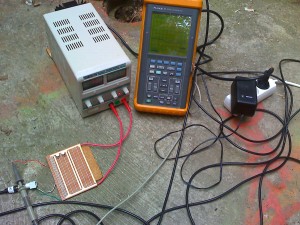
First setup:
First experimental setup

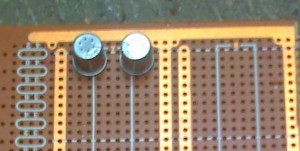
The Figaro gas sensors mounted on a piece of Veroboard:
veroboard2-300x151

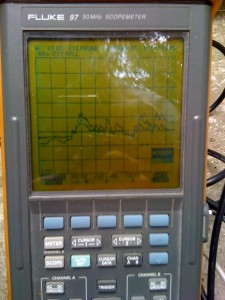
View of the big scary Arduino used to plot the first graphs. 1min/div. Looks like it’s working as both smell (from the chemical factory) and measured voltage go up during the third minute:
IMG_0312-225x300

More to come soon!

Stages au /tmp/lab – internships

Vous voulez avoir un stage intéressant? Travailler sur de l’Open Source? Ne pas bosser pour des prunes pour Google? Bosser avec des gens venant d’horizon variés et possédant une vraie passion et une vraie expertise technique (wow, ca commence a ressembler a une pauvre annonce de RH toute naze 😉 hehe), eh bien maintenant c’est possible car on ouvre les stages au /tmp/lab. Contactez nous si ca vous interesse.

Want to have a cool internship working on open source software? Don’t want to work for peanuts for Google? Want to have your own agenda? Join the /tmp/lab and make your internship into a unique experience. French or English speaking welcome.

Plus de détail sur les sujets possibles / More details on possible subjects:
http://dev.tmplab.org/issues/show/97

Some of the proposed projects:

  • Streamster2: Easy to use, Advanced TOR-like network
  • HostileWRT: Shell, C or Lua code on WiFi, security, audit, embedded platforms.
  • RubySCTP: Ruby SCTP stack with the same API as pySCTP (based on lksctp / SCTP socket API)
  • FasterJasperRb: Ruby Jasper Reports accelerated report server (as suggested in http://wiki.rubyonrails.org/rails/pages/HowtoIntegrateJasperReports)
  • Redmine improved interface to manage bugs and edit Wiki
  • Input engine for Redmine Wiki (to make it accept Trac wiki syntax, Mediawiki syntax, …)
  • BrokenTV key: Linux-based USB key for journalism in censored/hostile territories
  • BrokenTV platform: Free and Open source platform for Open / Mutable Web TV broadcasting
  • Anti-MitM: Detect and block Man in the Middle attacks with forged SSL certificates
  • …

if you have a project you’d like to propose, please tell us, we are also welcoming outside student / research projects.

Toxic Gas Sensors

Those of you who have been to the /tmp/lab may have experienced the delicate smells of the nearby chemical factory.

We want to learn more about this pollution, so we will implement an automated measurement system.

To monitor the air concentration of pollutants, we use cheap sensors made by a company called Figaro. The models used are TGS2600 and TGS2602; the same are used by the FridaV project. The TGS2600 measures contaminants such as hydrogen and carbon monoxide, while the TGS2602 detects ammonia and hydrogen sulfide (that we think is responsible for the occasional foul smells at the lab).

The outputs of these sensors is digitized and sent to an advanced Arduino called Fonera. It even has 802.11! And it can run Linux! Those features of this Arduino for experts (we hope we will be still able to use it despite our little DIY skills) make it perfect to post automatically the results on the web, by using the popular Twitter for example.

We are thinking about using a SPI analog to digital converter, as the Arduino hardware seems to be able to handle it.

More to come soon, check out the wiki page.

FPGA Workshop #3: Computer Architecture, August 29th

Computer architecture is the science and art of selecting and interconnecting hardware components to create computers that meet functional, performance and cost goals (Wikipedia).

With the invasion of digital devices during the last decade (cellphones, wireless routers, digital TV…), it has become more than ever ubiquitous.

However, it is still a poorly known subject for most people. Even among the self-proclaimed hardware hacking community, most fanatics of the Arduino development board open source physical computing platform do not know that all the functionality of their much-hyped toy comes from an AVR microcontroller chip that has been being manufactured for years by Atmel. And among those who know, yet fewer people are knowledgeable about the inner working of the AVR microchip; in which computer architecture plays an important role.

The reason behind this might be that during decades, computer architecture was reserved to academic lectures and companies who had enough cash to build integrated circuits costing several hundreds of thousands of dollars. This left little room for the individuals, except those who had the guts to wire together hundreds of logic ICs together. But these amateur systems lag well behind commercial solutions in terms of performance, size, and power consumption.

But today’s falling costs of powerful FPGAs make it possible for individuals to build complete high-performance computer systems (System-on-Chips) from scratch.

This workshop will explore this possibility. After introducing basic computer architecture concepts and practices, we will load a simplified version of the Milkymist System-on-Chip design in the development boards and execute basic programs on it. Then, using Verilog HDL, we will design a simple peripheral for the system-on-chip, integrate it, and test it on the board.

This workshop is for people who want to discover practical computer architecture, and at the same time for those who already know about architecture and want to get an introduction about how to add a peripheral to the open source Milkymist System-on-Chip.

Date: August 29th, 14:00
Venue: /tmp/lab geek collective
Price: Free
Info+Registration: Workshop page

Distributed Crypto SAT Solving workshop, Sept 10th

In this workshop led by Mate Soos (PhD in INRIA Rhone-Alpes) we will take a distributed SAT solver design that works similar to SETI@Home and hack it until it works faster, gives better results. The results will be public and the solver downloadable, along with the server to enable anyone to crack much-hyped but useless crypto-systems using collaborative effort.

SAT solvers are mathematical tools that solve problems given in the CNF notation. Since all problems can be described in CNF, in particular, cryptographical problems, SAT solvers can be used to crack ciphers. They have already been used to solve Crypto-1, used in London (20 seconds to break the encryption…) and HiTag2, used in car immobilizers.
Difficult cryptographic routines such as those used in WPA (wireless internet access), SSL (bank transactions), etc. need much more computing power than older ciphers. This means SAT solvers must be designed to work in a distributed environment, and work similar to SETI@Home or Folding@Home.

Date: September 10, 2009
Location: /tmp/lab, near Paris
More info+Registration: Worskshop page

HSF Build-Up In Progress

The Hacker Space Festival preparation is well under way. Already, people from the Netherlands, Germany, Greece and Sweden showed up. More than 200 registrations were made so far and we’re waiting for the crowd to show up on Saturday morning. Meanwhile, if you’re around and want to give a hand during build-up, you’re welcome anytime: most of us are already in hack-mode and won’t leave the place before the end of HSF.

Check the directions on the hackerspace.net website.

/tmp/toor Tour Of Other Routes

Hellekin and LeKernel have started road trips of hackerspaces around Europe.

The first /tmp/toor took place in May, gathering greetings for the Metalab’s 3rd birthday from Karlsruhe, Munich, Linz, Prague, Dresden, Leipzig, Berlin, Hannover, Amsterdam, Eindhoven, Brussel, Luxemburg, Köln and Paris. The materials gathered during the trip are available at http://hellekin.cepheide.org/HSET/

One month later, LeKernel toured Northern and Central Europe from Paris to Brussel, Bochum, Hannover, Berlin, Dresden, Leipzig, Weimar, Frankfurt, Darmstadt, Wiesbaden, Luxemburg, and Nancy.

July will see yet another tour, this time of Italy. Stay tuned! Watch http://wiki.tmplab.org/index.php/HackerSpaceEuroTours

Hacker Space Fest Schedule – 26th to 30th of June 2009, France.


========================================================================
== Hacker Space Festival #2: Program for 26-30 June 2009, Vitry/Seine ==
========================================================================

We are proud to announce the HSF program for the events which will
happen from the 26th to the 30th, of June 2009 at the /tmp/lab & 6 Bis
in Vitry sur Seine.

Hacker Space Fest aims to be an open forum for exchanges on
Hacking, Art, Technology, Freedom, Openness and Society, and as
such we wish to meet all of you who are contributing to these fields,
individually or as an integrated domain.

We'd like to thank all the people who sent us proposals, as well as the
Programming Committee for their time and dedication. Thank you all of
you who proposed your side-effects and helped make this program
festival even better. See you there!

Make sure to register, more information here:

http://www.hackerspace.net/register

(For short, to register, please send a mail to hsf-contact@tmplab.org
with "Subscribe" as the subject.)

The official program with details and the latest updates can be found
online:

http://hackerspace.net/schedule

See you there,
The Organizing Committee 🙂

========================================================================
== Table Of Contents ===================================================

* Friday 26th June: Build-up / Help welcome
* Saturday 27th June: Conference Day #1
* Sunday 28th June: Conference Day #2
* Monday 29th June: Conference Day #3
* Tuesday 30th June: Workshop Day
* Ongoing Events
* Food
* Lightning Talks
* Registration
* Subscribe to the HSF-TALK Mailing-List

========================================================================
== SATURDAY 27 JUNE : CONFERENCE DAY #1 ================================

09:00 - 10:00 Keynote Speech: Groogle Summer of Crode,
by Serguey Grim, Eric Schmoudt, Larry Fake (EN)

10:00 - 11:00 Les activismes contemporains,
by Laurence Allard & Olivier Blondeau (FR)

11:00 - 12:00 SIGKILL imminent - Novel Robot Uprising Mitigation
Strategies,
by astera (EN)

12:00 - 13:00 Sauerkraut hacking,
by Doctor Ferrand & Mister Rébus (EN)

13:00 - 14:00 Lunch Break

14:00 - 15:00 Fabrication de Biodiesel,
by Gaëtan & Sébastien Bourdeauducq (FR)

15:00 - 16:00 HostileWRT,
by Itzhack & Mr. Parkinson (EN)

16:00 - 17:00 Subverting Windows Embedded CE 6 Kernel,
by Petr Matousek (EN)

17:00 - 18:00 ICT Disaster Recovery,
by Jaromil (EN)

18:00 - 20:00 Round Table I: ICT Disaster Recovery (EN)
-> Facilitator : Jaromil
-> Participants: Isazi, Xenon (more to come)

20:00 - 21:00 Dinner Break

20:00 - 23:00 Concerts and performances

23:00 - 07:00 DJs & VJs

========================================================================
== SUNDAY 28 JUNE : CONFERENCE DAY #2 ==================================

09:00 - 10:00 The only mov(i)e is... Hackers in movies,
by Caspar Clemens Mierau (EN)

10:00 - 11:00 Gaming Platform Libre,
by Laura Bécognée & Yann Guidon (FR)

11:00 - 12:00 NutIP : un serveur web pour calculatrice HP-41,
by Khanh-Dang NGUYEN THU LAM (Paris) (FR)

12:00 - 13:00 Linux et le GSM,
by XXX (FR)

13:00 - 14:00 Lunch Break

14:00 - 15:00 The Virtual Hacker Space Room,
by hellekin (EN)

15:00 - 16:00 Milkymist: an Open Hardware VJ Platform,
by Sébastien Bourdeauducq (EN)

16:00 - 17:00 Blender Game Engine + ODP = Sexy Presentation,
by Kevin Roy (FR)

17:00 - 18:00 HackerSpaces Status Updates:
- the un/loquer in Medellin, by Alejo Duque (EN)
- Syn2Cat in Luxembourg, by Steve Clement (EN)

18:00 - 20:00 Round Table II: The Future Of Hackerspaces (EN)
-> Facilitator : Philippe Langlois
-> Participants: Alejo Duque, astera, Casper Clemens
Mierau, hellekin, Jaromil, Steve Clement

20:00 - 21:00 Dinner Break

========================================================================
== MONDAY 29 JUNE : CONFERENCE DAY #3 ==================================

09:00 - 10:00 Scrying,
by Martin Howse [remote from Berlin] (EN)

10:00 - 11:00 OpenCV anonymization,
by jilt (EN)

11:00 - 12:00 La face cachée des moteurs de recherches,
by XXX (FR)

12:00 - 13:00 Pushing the Limits in Open Source Licensing, and beyond,
by Philippe Langlois & Thiago Alves Maximo (EN)

13:00 - 14:00 Lunch Break

14:00 - 15:00 Vacuum tubes, your grandpa's electronics,
by Sébastien Bourdeauducq (EN)

15:00 - 16:00 AANN - Artificial Analog Neural Network,
by Phil Stearns (EN)

16:00 - 17:00 Hackers & Painters,
by Milovann Yanatchkov (EN)

17:00 - 18:00 EU Software Patents v3.0: The Patent Empire Counter
Attack,
by Benjamin Henrion (EN)

18:00 - 20:00 Round Table III: Internet : liberté graduée et ripostes de
la création (FR)
-> Facilitator : Jean-Marc Manach
-> Participants: to be announced

20:00 - 21:00 Dinner Break

========================================================================
== TUESDAY 30 JUNE : WORKSHOP DAY ======================================

Lightning Talks can be proposed until the last minute according to the
available space-time. See http://hackerspace.net/lightning-talks

10:00 - 13:00 Lightning Talks (20 minutes)

10:00 - 13:00 FPGA & Verilog workshop preparation

10:00 - 12:00 Metasploit workshop, by Jérôme Athias (EN/FR)

13:00 Lunch Break

14:00 - 20:00 Lightning Talks (20 minutes)

14:00 - 18:00 FPGA and Verilog introduction, by Sébastien Bourdeauducq
(EN)

16:00 - 18:00 Logiciel libre, standards ouverts et conservation des
œuvres d'art numérique, by Anne Laforet (FR)

20:00 - 21:00 Dinner Break

========================================================================
== ONGOING EVENTS ======================================================

For the whole duration of the festival...

== Ongoing RepRap Event

Alexandre Korber will setup an ongoing RepStrap build during the whole
festival, from A to Z.

The workshop will be split in several activities:

1. Soldering of the electronics components on an Arduino basis
2. Building of the 3-axis robot
3. Building of the extruder head
4. Calibration and tests

========================================================================
== FOOD ================================================================

Last year, we had a lot of vegetarian food. This year, it'll be organic
vegetarian food 🙂

Please register yourself by sending a mail to this address if you wish
to eat onsite: hsf-food@tmplab.org

========================================================================
== LIGHTNING TALKS =====================================================

Lightning Talks are open to anyone until the last moment, according to
the available space-time and will take place all day of Thursday 30
June 2009 in the conference room. Lightning talks will be held on
Tuesday. Each talk is to be 20 minutes, no more.

Please send your proposal to the HSF-TALK mailing-list so we can update
the wiki for you (you have to subscribe first):

http://lists.tmplab.org/listinfo.cgi/hsf2009-talk-tmplab.org

More information:

http://www.hackerspace.net/lightning-talks

========================================================================
== REGISTRATION ========================================================

To register, please send a mail to hsf-contact@tmplab.org with
"Subscribe" as the subject.

You'll be invited, in the confirmation email, to give a donation for
the participation to Hacker Space Fest.

The suggested donation price if 40 EUR (forty). Half-price for
students, unemployed and seniors.

Registering is a good idea as it will ensure you for access to the
conference:

1. All people having paid the full donation price in advance are
SURE to get in.

2. All people having paid some donation (but not the full donation)
will get in all the time, EXCEPT if there are too many people
inside the rooms at a given time.

3. All people having registered online (here) will have priority
during onsite registration

4. All people not registering online will have to pray that not so
many people come to HSF 😉

========================================================================
== THAT'S ALL FOLKS ====================================================

Follow-up on the HSF-TALK mailing-list:

mailto:hsf-talk-subscribe@lists.tmplab.org